
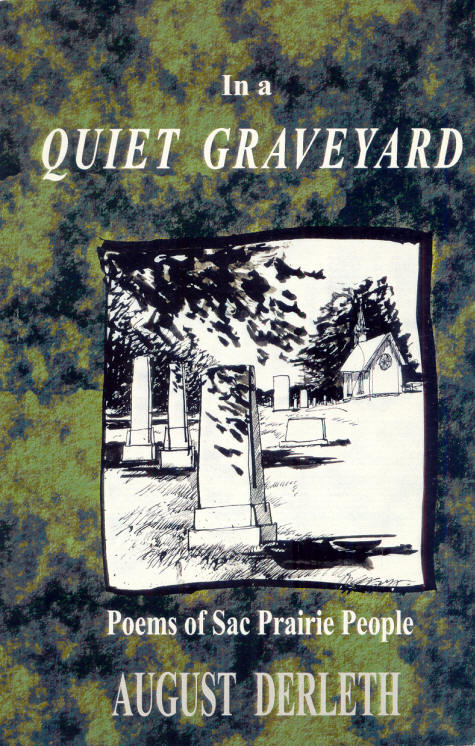
Cover and Illustrations by Jean Pierre Cagnat
Quality Paperback, 131
pp.
ISBN 1-55246-002-9 @ $12.00
Introduction by Peter Ruber
Many of the poems are impressive in a kind of quiet, persistent, even-tempered
manner. Derleth at his best and that best is very good indeed..." So wrote the
Milwaukee Journal of August Derleth's Collected Poems (1967), in which the
author collected from almost a score of books those poems he most wanted to
preserve.
In a few well-chosen words a perceptive reviewer captured the essence of August
Derleth's poetry; the same may also be said of his Sac Prairie Saga — his
novels, short stories, and journal books. Outside of a select circle, Derleth
was not widely recognized as major influence or a driving force in the world of
poetry, primarily because he did not write poetry with an eye toward
publication. Most often writing poems was an introspective exercise to
strengthen his prose and to sharpen his powers of observation. Writing poetry
also provided him with an escape from the rigors of the steady stream of books
and stories that flowed from his typewriter during incredible bursts of creative
energy.
When he would decide to send occasional small groups of poems to a magazine, it
was only after ruthlessly weeding out dozens that he did not consider worthy of
publication. He often wrote to colleagues, and repeated in lectures, that he was
a minor poet. Because he applied such tough critical standards, he allowed only
a small portion of his entire output to appear in book form.
Most of Derleth's nineteen volumes of poetry were self-published over a span of
three-and-a-half decades, usually in elegant limited editions averaging 300-500
copies, by printers like Carroll Coleman of the Prairie Press, who set type by
hand and printed and bound them in the same fashion using distinctive papers,
typgraphic designs, and woodcuts. The best from these appeared in two large
collections — Selected Poems (1944) and Collected Poems — issued by commercial
publishers.
The vast wealth of Derleth's unpublished poetry waited to be discovered
twenty-five years after his death, among an incredible cache of unpublished
manuscripts hidden in his former home. Here we found some 1500 poetry
manuscripts and four collections he had assembled shortly before his death in
1971, treasures we intend to publish over the next few years along with his
other unpublished writings.
Derleth's poetry falls into three distinctive groups: poems of nature and the
environment; poems on the aspects of love; and incisive portraits of the lives
of quiet desperation led by the men and women of Sac Prairie, the fictional
milieu of his home town of Sauk City, Wisconsin. Only a dozen of the poems about
the Sac Prairie people were published in previous collections. All, we suspect,
were drawn from real-life. Early in life Derleth began to collect voluminous
notes about the people and the legends of those who had lived in the old houses
of his village. Some even appeared as recurring characters in his fiction and
journal books — people like Louisa Stoll, Poosey Lahman, Elka, the widow
Helgenau, and Beau Wardler. He neither condemns or pities them: he shows
compassion and deep understanding for human emotion and the human condition, and
he wrote about it in an exquisitely elegaic style.
It should be noted that Derleth's style is unique. It is neither free style
verse nor traditional in form. He cared little for the experimental school of
poetry; and other than a few early attempts to write poetry in traditional forms
like the sonnet, couplets and quatrains — each with its own distinctive rhyming
patterns — Derleth borrowed from both to create his own form of expression.
It might be said that Derleth wrote prose poetry, because much of his poetry was
formed out of prose-style sentences and notes he jotted down during his daily
walks on the periphery of Sauk City. One can see by reading those little
notebooks and from early, heavily corrected typed drafts, just how carefully he
crafted his words and phrases until he had achieved the right mood in as few
words as possible. Often his poems underwent revisions over a period of many
years before they wound up in print or in a pile of those he rejected.
We believe In a Quiet Graveyard has the ingredients to become as important as
Edgar Lee Masters' Spoon River Anthology, a landmark work that stood the
literary world on end when it was published in 1915. There are striking
similarities as well as significant differences between the two works. The main
similarity is that both deal with people who had lived in small, rural farming
communities. But whereas Masters lets each person speak from the grave and sum
up his or her own life, Derleth is the narrator, extracting the distinctive
flaws of character, the inability to love, and the self-imposed misery and
loneliness that followed them to the grave.
In Spoon River Anthology Masters broke away from the strictures of form and
rhyming patters and wrote each poem in free verse. Derleth is more creative.
Using lines of varying length with some considerable rhyming to punctuate a
mood, he creates a powerful and intense reading experience that often borders on
the hypnotic. It is difficult to say if Spoon River Anthology had a significant
influence on these poems or on Derleth's own poetry. Perhaps Spoon River
Anthology only reinforced his passion to write about his own microcosm, which,
in a sense, reflects the same characteristics and emotions people experience
wherever they live, whatever space of time.
And so we present In a Quiet Graveyard: Poems of the Sac Prairie People, an
important addition to the Sac Prairie Saga, by one of the most under-appreciated
creative artists of our times. We hope this series of new books by August
Derleth appearing under the "Hawk & Whippoowill" imprint will finally bring one
of America's most prolific and versatile writers the recognition he so richly
deserves.
— Peter Ruber
23 January 1997
Table of Contents: The Poems
Billy Sand
Buck Carringill
Eli Wembler
Old Matt
Mrs. John Streng
Father Meinrad Brunfels
Dr. Wolgang Lauss
Oscar Stuart
Charlie Techmann
Dr. Paul Tabor
Mrs. Warner-Glenn
Mrs. Emma Stillman
Nemo
Eliphas Mife
Jeb Sneeder
Elsie Medstrom
Bertram Bunn
Abner Hersey
Anson Boggs
Thomas Bardshaw
Lily Manzer
Daisy Vellairs
Wesley
Gunter Priell
Alec Somers
Ted Birkett
Bart Hinch
Lois Malone
Mary Kempe
Nell Barraclough
Mink Rossik
Christian Wingdon
Martha Wingdon
Hugo Blauenfeld
Rena Larriquer
Effie Kahlmann
Weldon House
Mrs. Eben Ford
Hunchback Joe
Hester Duff
John Streng
Jim Wetherby
Mrs. Herman Mehst
Esau Krell
Lucinda Frayle
Bob
Ilsa Lahmann
Henry Puli
Oliver Vair
Mrs. Clara Pell
Ethel Burns
Raynor
Father Hemel
Froly
Alonzo Merrick
Molly Pringle
Adner Pringle
Megan Hods
Randolph Gread
Amos Kled
Barney Yancey
Ada Legrand
Obbie Legrand
Kitty Vayne
Michael Vayne
Sister Bridget
Raymond Sturk
Joel Wingdon
Manda Horrigan
The Moore Twins
Ella Wecter
Mrs. Cory Venler
Dr. Leopold Abort
Rufus Straik
Rewey Shanks
Ed Garman
Gus Pillep
Sal
Ab Barto
Richard Monn
Mrs. Emma Liddi
Helen Merk
Clara Halgenau
The Widow Halgenau
Mrs. Louisa Stoll
Poosey Lahman
Mrs. Samuel Lazar
Elky
Lawyer Beem
Ralsa Hollascz
Ginny Blye
Albertina
Old Mike
Jo
Asey Gratz
Goadby Deckerman
Karl Lahmann
Esther Minex
Mrs. George Halgenau
Beau Wardler
Josef Meier
Sadie Galway
Doc Raney
Lute Brenner
Doctor Flemberg
Hen Mamund
Quintus Flack
Sophie Hornly
Old Joe I
Old Joe II
Barney Ferle at 93
Barney Ferle at 97
John Siebers
Deserted Farm
Cemetery
Old Farmer
Ancestor
Grandpa Loney Reads the Wind
Grandpa Loney Says
Grandpa Loney Gathers Grapes
Grandpa Loney Reads the Catalogues